


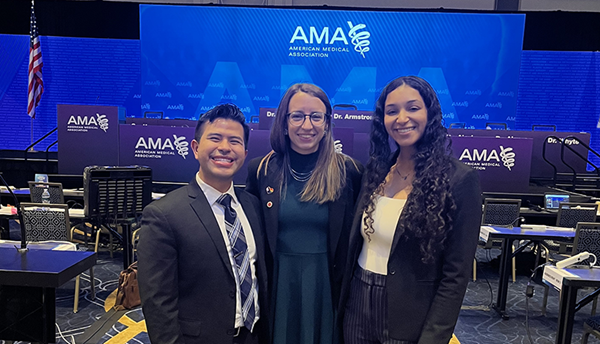
Emergency medicine residents and students were well-represented at the Interim meeting of the American Medical Association (AMA) Nov. 13–18.
The AMA meets twice yearly to debate and adopt policy and elect new leaders. The AMA acts as the voice of American physicians, communicating to the medical community and public and advocating to federal and state governments based upon decisions made at these meetings. It is crucial that emergency medicine trainees take part in these conversations. As your EMRA Representative to the AMA, I am honored to lead and organize the dedicated and passionate trainees who represent us.
Delegations to the Trainee Assemblies
The AMA's Medical Student Section (MSS) and Resident & Fellow Section (RFS) each hold meetings leading up to the AMA House of Delegates Meeting. During these Assemblies, the MSS and RFS debate proposed policies which, if adopted, will provide policy stances for each Section, guide actions taken by Section leadership, and would be forwarded to the AMA House of Delegates to be adopted as AMA policy.
During their Assemblies, students and residents hear from leaders in medicine, receive updates from AMA leadership, and hear updates from peer leadership in their own Sections. The MSS meeting featured updates and presentations on how federal agencies shape medical practice and education; op-ed writing; disability in training and care; and advocacy for occupational health. The RFS meeting featured presentations on H-1B visa challenges; advocacy for Medicaid; advocacy through social media; and protecting science.
Finally, Assembly meetings include elections. At this meeting the MSS elected Harsha Duddila Sripadrao as Chair-Elect and Kylie Ruprecht as the AMA Board of Trustees Student member. The RFS elected Dr. Laurie Lyn Lapp as Chair-Elect and voted to endorse Dr. Abhishek Jay Dharan as the candidate for the AMA-RFS member of the AMA’s Council on Science and Public Health.
ACEP and EMRA were excellently represented in the MSS Assembly by EMRA Medical Student Council members Danielle Sychowski and Matt Nguyen; and in the RFS Assembly by Dr. Anna Heffron, Dr. Jacob Altholz, Dr. Ian Brodka, Dr. Robert Dunn, Dr. Rebecca (Becky) Peoples, Dr. Betsy Rojas, and Dr. Shane Solger.
Advocacy in the House of Delegates
Trainees in the House of Delegates advocated on a number of high-priority items. Both the MSS and RFS debated resolutions regarding governance and elections structures and worked with allies to ensure trainee voices remain authentically and accurately represented. Trainees advocated for:
- Redressment of former misuses of anatomical specimens;
- Gender equity in disability insurance;
- Protecting access to the PSLF and student loans;
- Workplace accommodations for pregnant trainees;
- Rectifying disparities and harms caused by the Flexner report;
- Supporting Palestinian medical graduates experiencing hardship;
- Protecting scientific integrity and science in medicine;
- Protecting Affordable Care Act subsidies;
- Sustaining the AMA Journal of Ethics; and much more.
The Emergency Medicine Section Council (EMSC), which coordinates emergency medicine-related advocacy within the AMA, likewise advocated on a number of priorities with trainees’ assistance. Items raised by ACEP and by American Association of Emergency Medicine (AAEM) through collaborative advocacy included:
- Tail coverage for medical liability insurance;
- Prohibition of the corporate practice of medicine;
- Transparency in how the term “emergency department” can be applied.
Looking Forward to the Next Meeting
Your representatives to the AMA are already looking forward to advocating for emergency medicine trainees at the next AMA meeting, taking place in June 2026. I cannot state strongly enough how grateful I am for the hard work and dedication displayed by every trainee member of the delegation at this past meeting, and I am so proud of the changes we fought for.
Please reach out with requests, questions, or inquiries; if you are interested, I would love to help you get more involved. Organized medicine benefits from the passion and dedication of emergency trainees like you!