


A 54-year-old male with a history of chewing tobacco use presented to the emergency department with 3 days of progressive left-sided facial swelling, pain, fevers, and chills. Symptoms began 3 days prior with left posterior mandibular molar tooth pain and progressed into swelling and pain. He also reported pain with chewing and difficulty fully opening his mouth. He initially presented to an outpatient urgent care and received amoxicillin without improvement. He reported mild response to over-the-counter ibuprofen and denied dysphagia or drainage.
Vital signs on arrival: Temperature: 99.8°F, heart rate: 114 bpm, blood pressure: 153/74 mmHg, respiratory rate: 20, oxygen saturation: 98% on room air.
He was well-appearing, ambulatory, and tolerated supine positioning for imaging. On physical exam, he had left-sided mandibular swelling without purulence. He exhibited two finger trismus and severe tenderness to palpation. He noted some tooth pain on the same side but denied airway or breathing symptoms.
Laboratory evaluation showed: Na 133, K 4.4, bicarbonate 18, BUN 19, Cr 1.35, glucose 99, AST 69, ALT 52, WBC 11.6, Hgb 12.5, platelets 246, and lactic acid: 1.4.
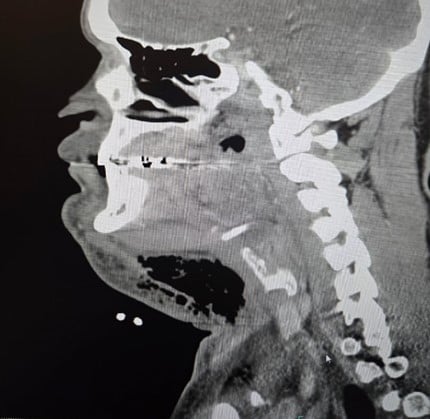
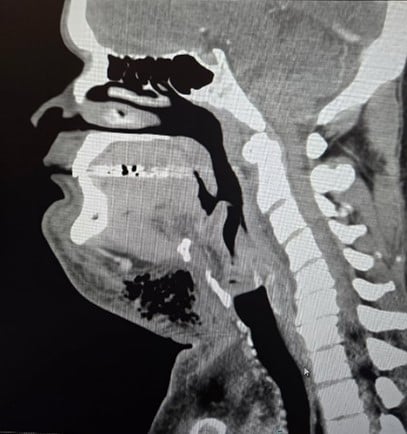
(Left: Figure 1 | Right: Figure 2)
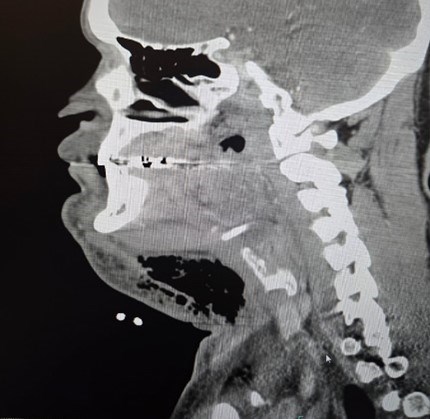
CT soft tissue neck revealed extensive soft tissue swelling with gas formation in the left facial and cervical regions concerning for necrotizing fasciitis, along with narrowing of the hypopharyngeal and laryngeal airway.
In the emergency department (ED), the patient received 1L of IV fluids and was started on IV ampicillin-sulbactam. Oral and maxillofacial surgery (OMFS) was consulted.
Introduction
Ludwig’s angina is an infection of the floor of the mouth that most commonly originates from an infection of the 2nd or 3rd molar tooth and spreads into the submandibular, sublingual, and submental space1,2. It is an aggressive infection that can spread and displace the contents of the mouth and throat and can result in airway compromise. Prior to the advent of antibiotics, the mortality for Ludwig’s angina exceeded 50%.2 It can also be complicated by gas-forming organisms, leading to necrotizing soft tissue involvement. Prompt diagnosis in the Emergency Department can lead to early and aggressive antibiotic administration, airway intervention, and surgical debridement if needed, leading to improved outcomes.
Airway Decompensation and Intervention
Approximately 5 hours later, the OMFS team notified the ED that the patient was developing new-onset dyspnea and increased facial swelling. Reassessment revealed marked progression of bilateral facial and neck edema with associated erythema. An intubation code was called for airway protection. The patient was evaluated at bedside, and the plan for urgent intubation and surgical drainage was explained. He consented to the procedure and underwent awake fiberoptic intubation without complication. He was admitted to the ICU with plans for operative intervention.
Surgical Management and Outcome
The following day, OMFS performed incision and drainage of the submandibular and submental spaces. Intraoperative cultures grew mixed anaerobic flora. The patient remained intubated for airway protection and underwent serial washouts. He was eventually extubated.
Discussion
This case demonstrates the importance of promptly identifying the symptoms of Ludwig’s Angina. This patient initially presented with mild symptoms and no signs of airway compromise. His diagnosis was missed at the urgent care and his condition progressed to facial swelling and pain, prompting him to present to the Emergency Department (ED). His condition progressed to complete airway collapse, requiring intubation within a few hours of his arrival.
The presence of soft tissue gas raised concern for a necrotizing infection, requiring aggressive management. While Ludwig’s angina is often bilateral, unilateral presentations can occur. CT imaging is key for assessing extent and guiding surgical planning.
In the management of Ludwig’s angina, airway protection is the single most critical priority. Although consultation with ENT and anesthesia is essential, emergency physicians are often the first providers capable of securing a compromised airway in time. In the rapidly evolving airway of Ludwig’s angina, emergency intubation may become necessary before a controlled OR setting is available.
The preferred approach is nasal fiberoptic intubation. Fiberoptic laryngoscopy is often carried out first to assess the airway and examine for swelling.1 If intubation is unsuccessful or not possible, tracheostomy is the most widely recommended means of airway control. Antibiotic choices include ceftriaxone plus metronidazole, or ampicillin-sulbactam.3
The use of steroids is controversial as their efficacy is debated, but they are routinely given. Prior to intubation, racemic epinephrine can be used to delay airway collapse, but there is not enough evidence to suggest that it prevents intubation.4 Emergency physicians must maintain vigilance, anticipate deterioration, and coordinate care with anesthesia and surgical teams as discussed to avoid critical loss of an airway.
Conclusion
Ludwig’s angina is a rapidly progressing and potentially fatal infection that requires rapid identification and management. Patients can present at any point and with any symptom within the spectrum: this includes molar tooth pain to facial swelling, to airway compromise. When suspicion is high for Ludwig’s angina, it is important to anticipate airway compromise. Any stridor, trismus, or difficulty speaking should signal immediate preparation for intubation. Emergency clinicians play a central role in early diagnosis, empiric management, airway planning, and coordination with surgical teams. Disposition is either ICU or OR depending on surgical urgency.
References
- Matuschak GM. Ludwig angina. In: Arbo JE, ed. UpToDate. Wolters Kluwer. https://www.uptodate.com/contents/ludwig-angina. Accessed June 3, 2025.
- Candamourty R, Venkatachalam S, Babu MR, Kumar GS. Ludwig's angina—An emergency: A case report with literature review. J Nat Sci Biol Med. 2012 July;3(2):206-208.
- Arbo JE, ed. Deep neck space infections in adults. UpToDate. Wolters Kluwer. https://www.uptodate.com/contents/deep-neck-space-in-adults. Accessed June 3, 2025.
- Briggs B. Episode 158: Ludwig’s angina: When a tooth can kill. EM Board Bombs Podcast. Published Jan 1, 2023. https://www.emboardbombs.com/podcasts/158-ludwigs-angina-toothache-from-hell. Accessed June 3, 2025.