


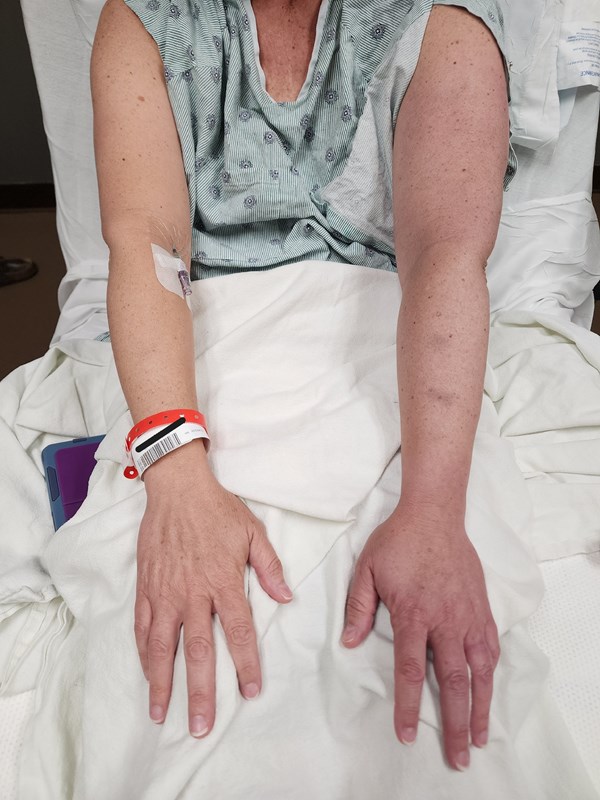
Acute, seemingly unprovoked DVT was diagnosed with bedside POCUS after the patient had a repeat doppler ultrasound of the upper extremity that was negative one day prior. This case highlights the importance of not anchoring toward or away from a diagnosis when a test is negative, especially when the history and physical exam point at a particular clinical diagnosis. Knowing when to repeat imaging, perform bedside POCUS, and read your own imaging are all skills that every emergency medicine physician should have.
Introduction
Phlegmasia Cerulea Dolens is a severe form of DVT that is associated with a high morbidity and mortality rate. It is more frequently found in the lower extremities, but can affect upper extremities as well. Without immediate treatment, patients can experience loss of life or limb. It is important to recognize the signs and symptoms, as well as how to diagnose the condition.
Case
A previously healthy 48-year-old female with a remote history of hypothyroidism, and hypertension no longer being treated, presented to the emergency department with three days of arm swelling, discoloration, and pain. Her prescription medications included 112mcg of levothyroxine and an oral contraceptive pill used for heavy menses and family planning. She had seen her primary care provider two days prior for arm pain and swelling; her PCP was concerned for a blood clot and ordered an upper extremity ultrasound with doppler, which was read as negative for DVT. It was assumed there was no blood clot, and she was prescribed steroids for the swelling. Her first symptom was a feeling of heaviness in the arm when she was washing her hair- she noted that she could not keep her limb above her head for more than a short period of time. Her hand then became swollen to the point she had to remove her wedding band secondary to pain. On the day she presented to the ER, she stated that she noticed her left arm was becoming discolored as well.
Patient denied chest pain and shortness of breath, but endorsed arm pain, swelling, and discoloration. She had no other complaints. Physical exam showed marked swelling in her left upper extremity, with tense skin noted in the forearm and hand. She had full range of motion, pain that was not exacerbated or relieved by positioning, and notable discoloration with a line of demarcation that was circumferential around her mid upper arm; the rest of the physical exam was unremarkable. Basic lab work and EKG were within normal limits. Bedside POCUS was performed. Deep and superficial veins were all easily compressible in the forearm; in the upper arm, cephalic and basilic veins were compressible. At this point, the patient was positioned supine with her left arm above her head and the basilic vein was tracked proximally to the axillary vein, with the probe at the level of her axilla. There was a visible clot within the vein, which was no longer compressible. Upper extremity doppler ultrasound was ordered and the ultrasound technologist was instructed to ultrasound the entirety of the upper extremity, with suspicion of DVT in the axillary and possibly the subclavian veins. CTA of the chest with runoff was ordered to evaluate the arterial structures, look for compression of vessels secondary to anatomy or malignancy, and to rule out PE in the setting of DVT.
Doppler US was positive for a significant DVT measuring approximately 5cm in the subclavian and axillary veins. CTA was negative for arterial disruption, malignancy, and PE. The patient was placed on a heparin drip, and admitted to the hospital with vascular surgery and hematology/oncology consulted.
Outcome: Vascular surgery recommendations included compression, elevation, and not using that arm for blood pressure reads or IVs; they agreed with the heparin drip and did not recommend emergent surgery at this time. Hematology evaluated the patient and believed that her prescribed oral contraceptive could have provoked the DVT and recommended discontinuation of the medication as well as anticoagulation for three months with an outpatient hypercoagulable workup.
In a follow-up call to the patient, she explained that approximately five weeks after being seen in the emergency department, vascular surgery wanted to perform a mechanical thrombectomy, and when they attempted to retrieve the clot, it was no longer present. However, the patient had a severely compressed subclavian vein, indicating thoracic outlet syndrome. Unfortunately, she developed another clot at the thrombectomy catheter insertion site. Four weeks later, she underwent rib resection followed by recovery with physical therapy. She noted her upper limb discoloration was completely resolved. She had continued swelling with improvement in pain and range of motion of the extremity.
Discussion
Due to the patient’s initial doppler US of the upper arm being read as negative for DVT, it was assumed that the patient did not have a blood clot despite having symptoms that correlated with phlegmasia cerulea dolens: swelling, pain, and discoloration of the skin. The ultrasound could have been read as negative for many reasons; it is possible that the limb was not scanned proximally enough to visualize the axillary vein. The clot burden also may have increased in the 24 hours between the two ultrasounds, making it more visible the next day. However, clinically, her symptoms were still highly indicative of DVT. Although phlegmasia cerulea dolens is uncommon, even more so in the upper extremity as opposed to the lower, it should still be on the differential when patients present with pain, swelling, and discoloration of a limb. One retrospective study of a 17-year time period in Madrid, Spain, discovered an incidence of PCD of 1:73,000,1 indicative of the rarity of this disease process. Treatment of PCD ranges from conservative measures including wrapping and elevating the limb and using anticoagulants for an extended period of time, to thrombectomy, to using anticoagulants and leech therapy.2 In this case, conservative measures were utilized and the patient was prescribed Eliquis for 90 days, in addition to being instructed to stop using her oral contraceptive pills, and continuing care outpatient.
Conclusion
Although rare, PCD is a disease process that every emergency physician should be aware of, and have on their differential when a patient arrives with a painful, swollen limb. Imaging is a useful tool we all rely on; however, when the imaging does not support the clinical picture, it is necessary to repeat and/or perform your own imaging when possible.
Written consent was obtained from patient for publication of the case report along with usage of photos
REFERENCES
- Alonso J, Ly-Pen D, Sanchez M.Incidence and Characteristics of Phlegmasia Cerula Dolens. Intl J Contemp Med Res. 2019 Nov. 2393-915X
- Melchor J, Leong K,Edwards J. Phlegmasia Cerulea Dolens of the Upper Extremity Treated with Anticoagulation and Leech Therapy. J Vasc Surg Innovative Tech. 2023 Aug 18; 9(4):101296