


Bridging Health and Humanity: Gender-Affirming Care Saves Lives
Bridging Health and Humanity:
Gender-Affirming Care Saves Lives
Dec. 1, 2025
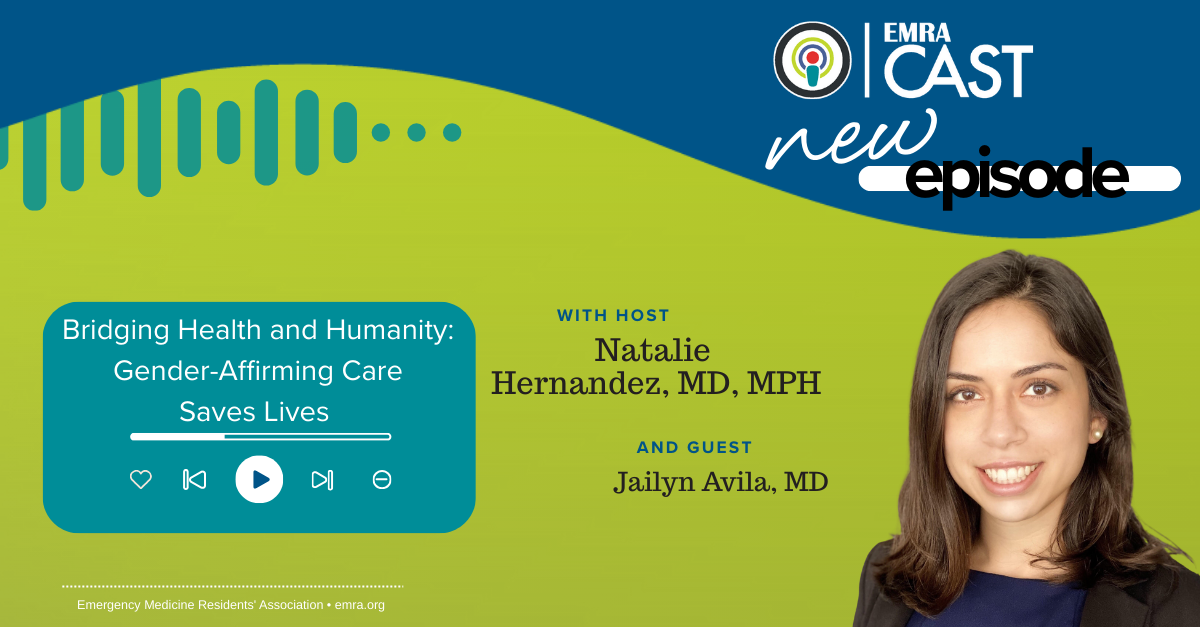
In this episode of EMRA*Cast's "Bridging Health and Humanity," host Natalie Hernandez interviews Dr. Jailyn Avila about the importance of gender-affirming care in the emergency department.







Host
Natalie Hernandez, MD, MPH
UCSF Medical Education Fellow, 2025
Harbor-UCLA EM Residency Class of 2025
EMRA*Cast Episodes
Guest
Jailyn Avila, MD
Ultrasound Fellowship Co-Director, United Health Services Southern California Medical Education Consortium
Co-Founder, Core Ultrasound
@Jailyn_Avi
OVERVIEW
In this episode of EMRA*Cast's "Bridging Health and Humanity," host Natalie Hernandez interviews Dr. Jailyn Avila about the importance of gender-affirming care in the emergency department. Dr. Avila highlights the significant health disparities and challenges faced by LGBTQIA+ patients, including a reluctance to seek care in the ED due to fear of discrimination and past negative experiences.
The conversation covers the critical aspect of treating trans patients with the same respect and care as cis patients, avoiding irrelevant medical questions, and implementing small changes in practice to create a supportive environment. Dr. Avila shares personal experiences as a transgender woman, emphasizes the necessity of advocacy, and provides actionable steps for clinicians to improve the care and trust of LGBTQIA+ patients.
The episode also addresses the impact of recent restrictive policies on the health care of trans individuals and calls for education, advocacy, and systemic change to support this vulnerable population.
Publisher's Resources
Please see EMRA's resources:
- Ornelas-Dorian C, Hsiang E. Caring for LGBTQIA+ Populations in the ED: A Quick Guide. EM Resident. Jan. 15, 2024.
- Lech CA. EMRA Transgender Care Guide. 2018.
- Transgender Care Guide – free module within the MobilEM app
Objectives
By the end of this episode, listeners will be able to:
- Describe key health disparities affecting LGBTQIA+ patients, including delayed care-seeking due to fear of discrimination and high rates of negative ED experiences.
- Explain how gender-affirming care reduces mental health distress and suicidality, and differentiate gender identity from mental illness.
- Recognize the impact of stigma, legislation, and societal discrimination on the health, safety, and health care access of LGBTQIA+ individuals.
- Demonstrate respectful communication practices, including the use of correct names and pronouns, and applying trauma-informed inquiry when asking potentially sensitive questions.
- Implement practical strategies to create an affirming ED environment, such as:
-
- Avoiding irrelevant or intrusive questions.
- Prefacing necessary but sensitive history-taking with clinical rationale.
- Correcting team members who misgender or misuse names.
- Identifying visible allyship cues (e.g., pronouns on badges).
- Distinguish relevant clinical considerations for transgender patients, such as:
-
- Risks associated with different forms of estrogen and androgen blockers.
- Typical hormone regimens and their implications in ED presentations.
- Understanding that risk profiles shift after hormone therapy.
- Apply best practices when caring for LGBTQIA+ minors, including private HEADSSS assessments, confidentiality around identity, and safe documentation practices.
- Identify ways to advocate within restrictive or hostile environments, including speaking up, modeling allyship, and addressing bias at the institution or team level.
- Access reliable educational resources (e.g., The Trevor Project, Human Rights Campaign, EMRA LGBTQIA+ guides, Erin in the Morning) to continue building knowledge and advocacy skills.
- Recognize the importance of allyship and community support in improving health care experiences and outcomes for LGBTQIA+ patients.
References
- 2022 National Survey on LGBTQ Youth Mental Health. The Trevor Project. Dec 2023.
- Avila J. JailynAvila.com.
- Austin A, Avila J. Part 1: Transcending Boundaries: Dr. Jailyn Avila's Powerful Insights on Gender Identity. Youtube. Sep 5, 2023.
- Beral V, et al. Breast cancer and hormone-replacement therapy in the Million Women Study. Lancet. Aug 9, 2023.
- Dawson L, et al. LGBTQ+ Health Policy. Kaiser Family Foundation. Oct 8, 2025.
- Dawson L, Kates J. Overview of President Trump’s Executive Actions Impacting LGBTQ+ Health. Kaiser Family Foundation. Sep 25, 2025.
- Erin In the Morning
- Exton Rice, C et al. Sexual minority health disparities: an examination of age-related trends across adulthood in a national cross-sectional sample. Ann Epidem. Mar 2019.
- Lech C, Paris J, Shapiro A. EMRA Transgender Care Guide. EMRA. 2018.
- Orion Rummler, K. All the Ways Trump Wants to Exclude Trans People From Public Life. The 19th. Mar 5, 2025.
- Ornelas-Dorian C, Hsiang E. Caring for LGBTQIA+ Populations in the ED: A Quick Guide. EM Resident. EMRA. Jan 15, 2024.
- Overview: 2025 Executive Actions Impacting LGBTQ+ Health. National Coalition for LGBTQ Health. Jun 16, 2025.
- Trump Anti-LGBTQ+ Executive Order Litigation Tracker. The LGBTQ+ Bar.
- Warbelow, S. Understanding Executive Orders and What They Mean for the LGBTQ+ Community. Human Rights Campaign. Feb 6, 2025.