


Kratom: The Gas Station “Supplement” That Brings Patients to the ED with Special Guest Dr. Sean Nordt
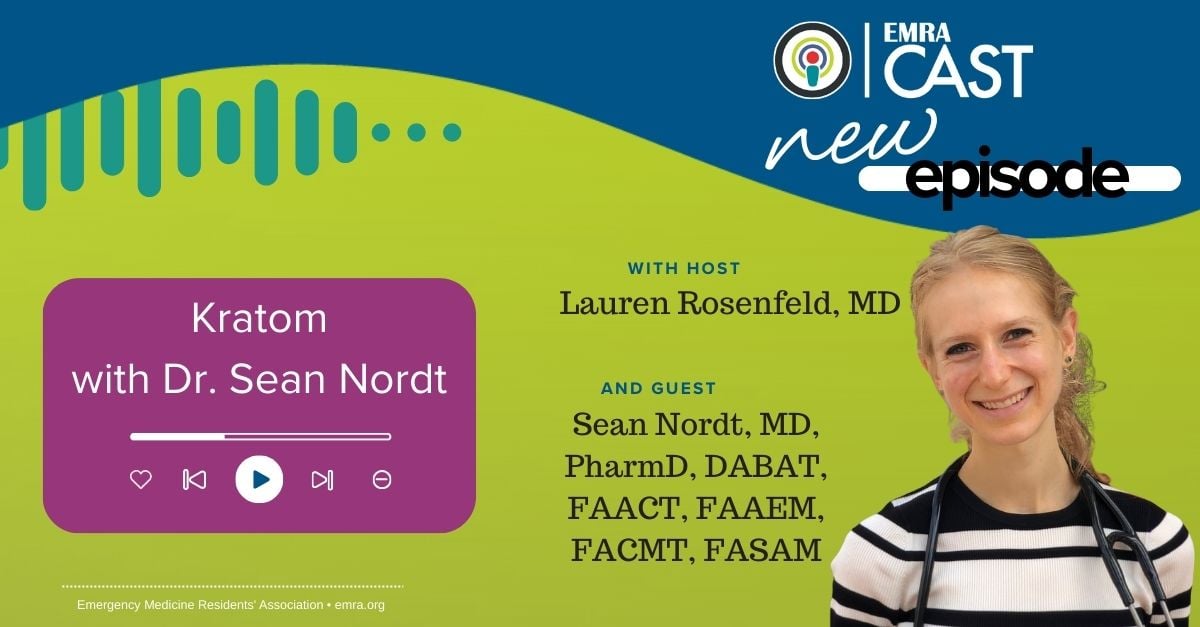
Kratom: The Gas Station "Supplement" That Brings Patients to the ED with Special Guest Dr. Sean Nordt
Feb. 1, 2026
Dr. Sean Nordt is an emergency physician, toxicologist, pharmacist, and educator with deep expertise at the intersection of clinical toxicology, addiction medicine, and frontline emergency care. As a former Poison Center director, he brings a wealth of insight to a discussion with host Dr. Lauren Rosenfeld. Tune in as Dr. Nordt explains an increasingly common—and often misunderstood—ED presentation: kratom.







Host
Lauren Rosenfeld, MD
George Washington University
Emergency Medicine Residency Class of 2026
@laurenatoregon on X; @laurenkrosenfeld on IG
EMRA*Cast Episodes
OVERVIEW
Dr. Sean Nordt is an emergency physician, toxicologist, pharmacist, and educator with deep expertise at the intersection of clinical toxicology, addiction medicine, and frontline emergency care. Dr. Nordt brings a unique perspective grounded not only in bedside ED experience, but also in systems-level toxicology leadership, having previously served as a Poison Center Director. He’s a passionate teacher with a gift for translating complex pharmacology into practical, high-yield clinical pearls for everyday emergency medicine practice. He breaks down an increasingly common—and often misunderstood—ED presentation: kratom.
Summary
Kratom (Mitragyna speciosa) is a plant-derived substance increasingly encountered in emergency medicine, often presenting as withdrawal more than intoxication. Users may take kratom for chronic pain relief, stimulant/euphoric effects, or as self-treatment for opioid use disorder—often based on internet guidance. Kratom dosing is typically in grams (1–8 g), with lower doses producing more stimulant effects and higher doses causing opioid-like effects via mu opioid receptor activity.
Clinical management is primarily supportive care, though naloxone may help if opioid toxidrome is present. A major emerging concern is the rise of 7-hydroxymitragynine (“7-hydroxy”), a more potent metabolite now being synthesized and sold in concentrated formulations, increasing risk for severe toxicity and adulteration (including fentanyl). ED clinicians should ask specifically about kratom and “herbal supplements,” counsel without stigma, and connect patients to addiction support when appropriate.
Discussion Questions
- What are the most common kratom presentations you’ve seen in your ED—withdrawal vs intoxication?
- How would you distinguish kratom intoxication vs opioid overdose vs polysubstance ingestion clinically?
- When (if ever) should kratom exposure lead to admission, and what level of care is appropriate?
- How do you counsel patients who use kratom because they believe “natural means safe”?
- Would you initiate buprenorphine in suspected kratom withdrawal, or stick to supportive withdrawal management?
- What are the pitfalls of using a urine drug screen to evaluate suspected kratom-related presentations?
TAKE-HOME POINTS
- Kratom use is rising, and ED presentations may be more commonly withdrawal than intoxication.
- Kratom is marketed as “natural,” but natural ≠ safe — dosing, purity, and ingredients are often unreliable.
- Dosing is typically in grams (1–8 g):
- Lower doses → more stimulant/euphoric effects
- Higher doses → more opioid-like effects (mu receptor activity)
- A major emerging danger is “7-hydroxy” (7-hydroxymitragynine): a more potent compound increasingly sold in concentrated/synthetic forms.
- Adulteration is a serious concern, including reports of fentanyl contamination in some products.
- Routine urine drug screens do NOT detect kratom and can be misleading—interpret carefully and clinically.
- Management is mainly supportive care; consider naloxone only if an opioid toxidrome is present.
- Disposition depends on symptoms:
- Mild/asymptomatic after observation → discharge with clear return precautions
- Persistent/moderate–severe symptoms → admit to a monitored setting
- Kratom withdrawal can resemble opioid withdrawal (GI symptoms, insomnia, pain/anxiety) → treat symptomatically (e.g., clonidine, antiemetics, supportive meds) and connect to addiction follow-up.
- Best practice: ask directly about kratom and “herbal supplements,” since many patients don’t think of them as drugs.
Resources
- emDocs. ToxCard: Kratom. Accessed January 14, 2026. https://www.emdocs.net/toxcard-kratom-2/
- Emergency Medicine Residents’ Association (EMRA). Kratom. EM Resident. Accessed January 14, 2026. https://www.emra.org/emresident/article/kratom
- MedPage Today. FDA general / kratom-related public health article. Published July 30, 2025. Accessed January 14, 2026. https://www.medpagetoday.com/publichealthpolicy/fdageneral/116731
- American Association of Poison Control Centers (AAPCC). National Poison Data System (NPDS) Annual Report. Accessed January 14, 2026. https://www.aapcc.org/annual-reports/
- Centers for Disease Control and Prevention (CDC). Morbidity and Mortality Weekly Report (MMWR). Kratom-related exposures and/or deaths. Accessed January 14, 2026. https://www.cdc.gov/mmwr/
- National Library of Medicine. PubMed. Search terms: “kratom emergency department,” “mitragynine exposures,” “kratom poison center.” Accessed January 14, 2026. https://pubmed.ncbi.nlm.nih.gov/
- US Drug Enforcement Administration (DEA). Drug and chemical information / intelligence bulletins relevant to kratom and mitragynine. Accessed January 14, 2026. https://www.dea.gov/
- Poison Control. National Poison Help Hotline: 1-800-222-1222. Accessed January 14, 2026. https://poisonhelp.hrsa.gov/